For many years, psychotherapy was understood primarily as a conversation. Therapists and clients explored thoughts, feelings, memories, relationships, and unconscious patterns. Dialogue remains central to therapeutic healing. But over the past several decades, many therapists have come to appreciate that emotional wounds also live in our bodies.
One of the most influential books in this movement is Bessel van der Kolk’s The Body Keeps the Score. Van der Kolk shows how overwhelming experiences—whether a catastrophic event or chronic emotional neglect, abuse, or instability—can become encoded in our nervous systems. Even after danger has passed, our bodies may respond as though it is still present.
Therapists often see this. Clients tell us, “I know I’m safe, but I don’t feel safe.” Their shoulders remain tense, their breathing shallow, their sleep disrupted, and their nervous systems on alert.
Not All Trauma Looks the Same
Many people think of trauma as experiences of combat, assault, or serious accidents. But trauma can also arise from growing up with unpredictable caregivers, living with criticism or emotional volatility, bullying, physical injuries, loss, or experiences of shame. Even the absence of consistent emotional attunement can leave imprints on the nervous system.
These experiences may lead to hypervigilance, anxiety, emotional numbing, intrusive thoughts, chronic muscular tension, or a persistent feeling that something is wrong—even when life is objectively going well.
The Rise of Somatic Therapies
This growing understanding has contributed to the development of somatic therapies such as Somatic Experiencing or Sensorimotor Psychotherapy. These approaches, which have growing evidence for their effectiveness, help the nervous system rediscover safety, flexibility, and regulation.
This development is deeply compatible with what Carl Rogers, the founder of person-centered therapy, taught decades ago. Emotional healing can begin when individuals experience safety, acceptance, emotional attunement, and authentic relationships. Somatic approaches extend these principles to bodily experience.
Where Qigong Fits In
Qigong (pronounced chee-gong) is an ancient Chinese healing practice that combines gentle movement, relaxed, rhythmic breathing, focused awareness, meditation, and imagination. It is used alongside Traditional Chinese Medicine (TCM) to heal emotional and physical injuries and prevent disease. Growing bodies of research support the benefits of mindful movement practices like qigong for healing from trauma, as well as for stress reduction, improved focus, pain management, emotional well-being, and overall physical health. Its simplicity and approachability make it an excellent form of somatic healing.
Qigong is a form of exercise, but it is not only about burning calories; it helps you gently and mindfully inhabit your body. It encourages practitioners to notice sensations with curiosity as they engage in relaxed, flowing motion. These qualities can help individuals regulate their nervous systems, be more connected to their bodies, and feel safe within themselves.
What I personally appreciate about qigong is its extraordinary gentleness.
Movements can be practiced standing, seated, or even lying down. The emphasis is usually less on stretching or holding postures and more on fluid and mindful movement.
There is also a distinctive emphasis on “felt imagery.” You might imagine gathering energy (“qi”) from the earth, expanding through the heart, floating through clouds, or feeling tension drain downward. Whether one understands these images literally or metaphorically, they can help people shift into a calmer, more integrated state.
How Is Qigong Different from Tai Chi?
Qigong and Tai Chi are closely related. In fact, Tai Chi can be understood as a form of qigong because it cultivates many of the same qualities: mindful awareness, coordinated breathing, relaxed movement, balance, and whole-body integration.
Tai Chi’s graceful forms have been refined over centuries and offer tremendous physical, emotional, and meditative benefits, as well as martial applications. Many practitioners find it to be a deeply rewarding lifelong discipline.
For beginners, qigong may be a gentle, approachable entry point. Most exercises can be learned in just a few minutes and offer calming and grounding benefits from the very first session.
A Few Movements
Different teachers use different names for each of these, but there are several movements you might find especially helpful:
Shaking the Tree uses gentle rhythmic shaking to release unnecessary muscular tension. Many people are surprised by how naturally their breathing changes after only a minute or two.
Parting the Clouds encourages expansive movements that open the chest while coordinating breath and attention. People often describe feeling more “spacious” inside.
Pushing the Waves uses smooth forward and backward movements that naturally synchronize with breathing. There is something deeply settling about its rhythm. Rather than fighting the current, the movement suggests working with it.
Qigong Can Also Be Relational
Although qigong is often practiced individually, it can also become surprisingly relational.
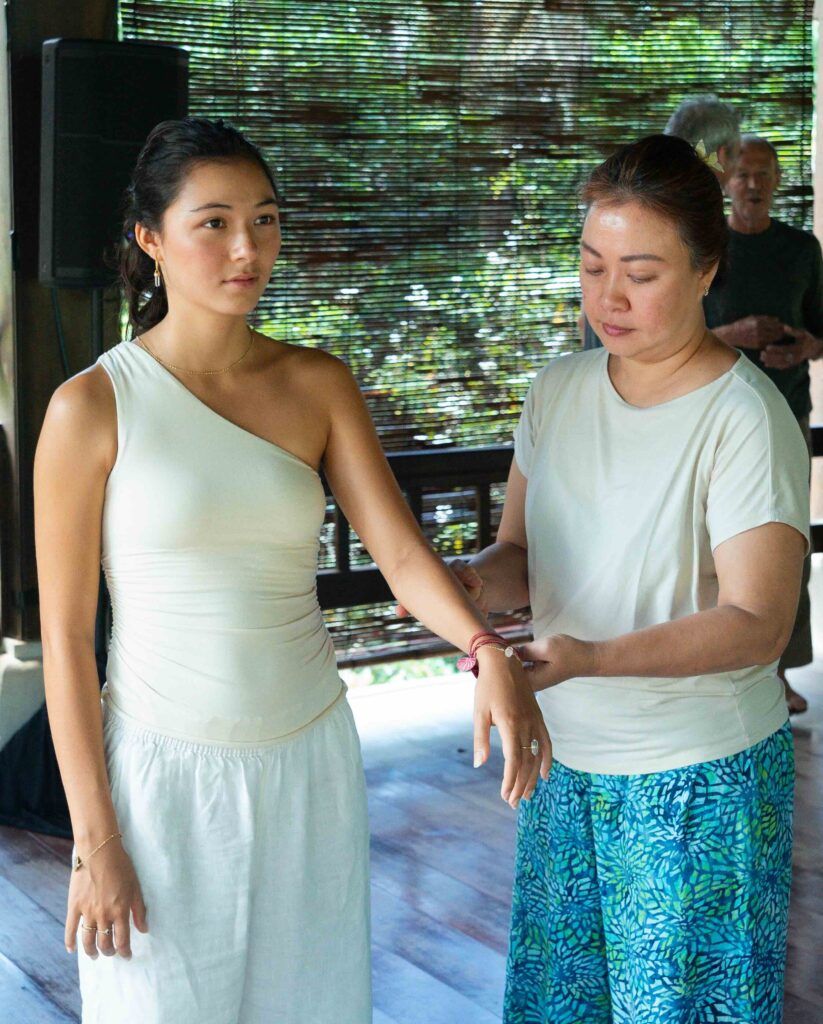
Partners can practice together, moving and breathing in synchrony. Families can learn simple movements as part of a daily routine. Parents and children may enjoy playful forms involving animals or flowing movements.
From a family therapy perspective, this is especially intriguing.
We often think of regulation as an individual skill. Yet decades of attachment research remind us that human beings regulate one another through co-regulation.
Shared movement can become another way to foster emotional safety—not as a replacement for conversation, but as a pathway toward connection, belonging, and trust.
Sometimes talking becomes easier after bodies have first learned to settle.
A Few Places to Begin
If you’re curious about exploring qigong, here are several resources I have found helpful.
For readers, I highly recommend Ken Cohen’s The Way of Qigong, perhaps the most comprehensive introduction available. The Healing Promise of Qi by Roger Jahnke clearly explains qigong concepts and offers a range of tools, practices, and techniques.
There are also many excellent online teachers. Marisa Cranfill’s YOQI program offers a thoughtful progression from basic awareness to increasingly sophisticated practice. Anthony Korahais of Flowing Zen presents qigong in a clear, welcoming style. Ken Cohen offers numerous online lectures and demonstrations that beautifully combine scholarship with decades of practical experience.
A Final Reflection
Sometimes our culture encourages us to approach healing the way we approach everything else: work harder, think harder, solve the problem.
Healing from trauma asks something different of us: to slow down, to notice, to breathe, to experience our surroundings, and to find safety within our minds and bodies. Sometimes it begins with a slow breath or a gentle movement. For people whose bodies have learned to anticipate danger, this can be profoundly restorative.
Recovery rarely comes from a single technique. It grows through safe relationships, compassionate curiosity, and practices that help both mind and body remember that danger has passed. For many people, qigong offers one gentle path towards healing.
-Posted by Jonah Green
Jonah Green, a therapist at Jonah Green and Associates, LLC, offers therapy services for children, teens, families, and adults in North Bethesda, Maryland, serving clients in Montgomery County, DC, and the surrounding areas.